
Scheme of Examination
Primary Section (Nursery to Class V)
The Central Board of Secondary Education (CBSE) follows a structured and uniform system of assessment designed to support the holistic development of students. The assessment framework aims to prepare learners progressively for higher classes while ensuring consistency in academic standards across schools.
In CBSE, the Primary Section generally includes classes from Nursery to Class V. During these foundational years, the focus is on nurturing essential skills, fostering curiosity, and promoting overall growth through continuous and comprehensive evaluation.
Classes: Nursery to II
For the early foundational years, the assessment system is informal, continuous, and learning-oriented rather than examination-driven.
Key Features
- No Formal Examinations: Students are not subjected to written or timed examinations.
- Continuous Observation: Teachers assess students through regular classroom interactions, participation, and developmental milestones.
- Focus Areas: Listening, speaking, reading, writing, numeracy skills, environmental awareness, creativity, and motor skill development.
Classes: III to V
The academic year is generally divided into two terms:
- Term I: April to September
- Term II: October to March
Assessment Components
- Continuous Assessment: Regular evaluation through class tests, oral assessments, assignments, and activity-based learning.
- Scholastic Areas: Assessment through periodic tests, half-yearly and annual examinations, notebook maintenance, holiday homework, projects, and subject enrichment activities.
- Co-Scholastic Areas: Evaluation of students' participation and performance in Art Education, Physical Education, Music, Dance, and Personal-Social Development activities.
The assessment process at the primary level is designed to encourage learning, build confidence, and develop a strong academic foundation for future classes.
Middle Compartment (Classes VI to VIII)
The Middle Compartment (Classes VI to VIII) marks a significant transition in a student's academic journey. At this stage, the focus shifts towards competency-based learning, conceptual understanding, analytical thinking, and the practical application of knowledge. In alignment with the National Education Policy (NEP) 2020 and the National Curriculum Framework (NCF) 2022, assessment is designed to support continuous learning, identify learning gaps, and encourage holistic development.
Assessment Approach
Assessment at the Middle Stage is both formal and competency-based. It aims to evaluate not only subject knowledge but also critical thinking, problem-solving abilities, communication skills, creativity, and overall learner development.
- Nature of Assessment: Formal and Competency-Based
- Methods: Periodic Tests, Mid-Term Examination, Annual Examination, Projects, Subject Enrichment Activities and Internal Assessment
- Focus Areas: Analytical Thinking, Logical Reasoning, Conceptual Understanding and Application of Knowledge
- Continuous Feedback: Regular feedback is provided to support improvement and academic growth.
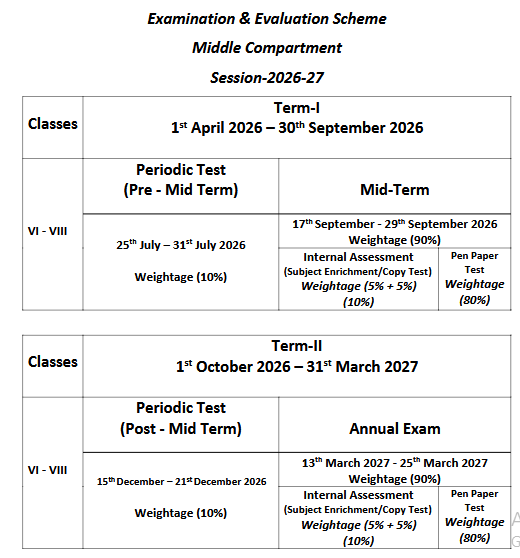
Examination & Evaluation Scheme (Session 2026-27)
The examination schedule and weightage pattern for Classes VI to VIII are as follows:
Assessment Objectives
- To develop cognitive and conceptual understanding among learners.
- To strengthen analytical thinking, logical reasoning, and problem-solving abilities.
- To enhance communication skills and encourage effective expression of ideas.
- To promote creativity, innovation, and independent learning.
- To nurture life skills, values, and responsible social behaviour.
- To encourage continuous improvement through regular feedback and self-reflection.
- To assess the application of knowledge in real-life situations.
- To prepare students for the Secondary Stage of education and lifelong learning.
The assessment system at the Middle Stage is designed to support holistic development by focusing on academic achievement, skill development, and overall learner growth. It encourages students to become confident, responsible, and lifelong learners.
Assessment Practices
- Use of oral, written and practical assessment tools.
- Focus on conceptual understanding and application of knowledge.
- Regular feedback to support continuous improvement.
- Encouragement of self-reflection and independent learning.
- Holistic evaluation of academic performance, skills and overall development.
The assessment framework emphasizes learning, growth and continuous improvement, ensuring that every learner receives opportunities to develop knowledge, skills and values in a supportive environment.